
From Manual to Intelligent: Why is 2026 the Turning Point for AI in Agriculture?
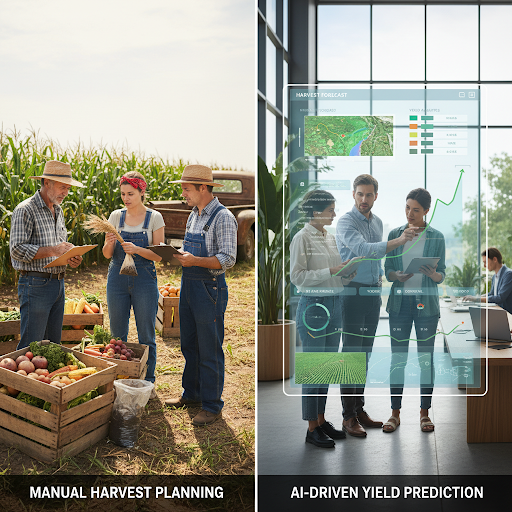
For decades, agriculture has depended heavily on manual processes, experience-driven decisions, and reactive problem-solving. But 2026 is proving to be a pivotal moment; a clear shift from traditional farming to intelligent, data-driven agriculture.
With challenges like labour shortages, rising input costs, climate uncertainty, and increasing demand for traceability, agribusinesses can no longer rely on guesswork. This is where AI-powered platforms like FarmERP are redefining how farms operate; turning data into actionable insights and operations into predictable, efficient systems.
1. The Limitations of Manual Farming
Traditional farming methods have served the industry for generations, but they come with clear limitations:
- Decisions based on experience rather than real-time data
- Delayed visibility into crop health and field conditions
- Manual record-keeping leading to errors and data gaps
- Difficulty managing large-scale or multi-location operations
As farms scale and markets become more demanding, these limitations directly impact profitability and sustainability. Even today, many agribusinesses struggle with inconsistent yield, high operational costs, and lack of clarity across operations.
2. What “Intelligent Agriculture” Really Means
Intelligent agriculture goes beyond digitization; it’s about using AI, data, and automation to make smarter decisions at every stage.
Instead of reacting to problems, farms can now:
- Predict yield, demand, and risks in advance
- Monitor crops in real time across multiple locations
- Optimize labour, inputs, and resources
- Track every activity with accuracy and accountability
This shift allows agribusinesses to operate with confidence, control, and predictability.
3. Why 2026 Is the Turning Point
Several forces are driving this transformation right now:
1. Rising Cost Pressures
Labour shortages are impacting nearly 60% of farms globally, increasing production costs significantly.
AI-driven labour optimization is becoming essential to manage efficiency and reduce waste.
2. Climate Uncertainty
Unpredictable weather patterns and loss of arable land are making farming more risky than ever.
Predictive AI models help mitigate these risks with early warnings and adaptive planning.
3. Shift Toward High-Tech Farming
Adoption of hydroponics, vertical farming, and greenhouse operations is accelerating, delivering higher yields with better resource efficiency.
These models rely heavily on data and AI for precise management.
4. Demand for Traceability & Compliance
Global markets now expect full traceability from farm to consumer. Manual systems simply cannot meet these expectations.
5. Availability of Scalable AI Platforms
Platforms like FarmERP Agribusiness Cloud are now making AI accessible, practical, and scalable for agribusinesses of all sizes.
4. The Role of AI in Modern Farm Operations
AI is no longer a futuristic concept; it is already embedded into everyday farm activities:
- Labour Optimization: AI tracks productivity, calculates wages, and improves workforce efficiency
- Crop Monitoring: Satellite data and image recognition provide real-time crop health insights
- Quality Control: AI-driven QC ensures consistency from field to dispatch
- Forecasting: Predictive models estimate yield, demand, and input requirements
- Traceability: Digital tracking connects every stage from production to market
These capabilities transform farms from reactive systems into proactive, intelligent operations.
5. How FarmERP Is Enabling This Shift
FarmERP plays a central role in this transformation by bringing all operations into a single, AI-enabled platform.
Unified Data & Operations
FarmERP connects planning, production, quality, finance, and sales into one system, creating a single source of truth for agribusinesses.
Real-Time Visibility
With mobile-based data capture and real-time dashboards, teams can track activities directly from the field, reducing delays and errors.
AI-Powered Intelligence
From pest detection to yield prediction and farmer-level insights, FarmERP integrates AI into everyday workflows through tools like AgIntel10X and FarmGyan.
Predictability & Control
By combining operational data with predictive analytics, FarmERP enables businesses to plan ahead, reduce risks, and improve profitability.
6. Real-World Impact: What Changes on the Ground
So what does this shift actually look like in practice?
- A farm manager no longer waits for crop damage; they receive early alerts and act immediately
- Labour costs become transparent and optimized through real-time tracking
- Exporters reduce rejection rates with digital quality control and traceability
- Greenhouses and hydroponic farms achieve higher yields through precise monitoring and automation
In short, decisions become faster, smarter, and more reliable.
7. The Road Ahead for AI in Agriculture
The transition from manual to intelligent farming has only just begun. Over the next few years, we can expect:
- Greater adoption of AI-driven automation
- Increased use of satellite and IoT-based monitoring
- Stronger focus on sustainability and resource optimization
- Fully connected farm-to-fork ecosystems
Agriculture is evolving into a data-driven industry where intelligence is the key differentiator.
8. Conclusion
2026 marks a clear turning point for agriculture. The shift from manual processes to intelligent systems is no longer optional; it is essential for survival and growth.
FarmERP is helping agribusinesses lead this transition by combining AI, real-time data, and operational control into one unified platform. The result is not just better farming; but smarter, more sustainable, and more profitable agriculture.
Ready to move from manual operations to intelligent farming?
Explore how FarmERP can transform your agribusiness with AI-powered insights, better control, and predictable outcomes. Visit farmerp.com to get started.