
Why Manual Scouting Fails in Large-Scale Farms
Summary
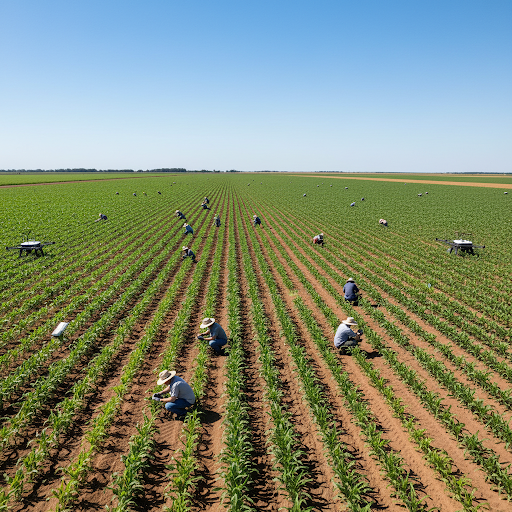
For decades, manual scouting has been the backbone of farm monitoring. Field workers physically inspect crops, observe pest activity, and assess soil and plant conditions. While this approach works for small farms, it becomes increasingly ineffective as farm size expands. In large-scale farming environments, manual scouting introduces delays, inconsistencies, and blind spots that directly impact crop health and productivity.
As agricultural operations grow across hundreds or thousands of acres, relying solely on human observation is no longer sustainable. Modern agribusinesses require faster, more accurate, and scalable ways to monitor their fields. This is where AI-driven, data-based solutions like FarmERP’s AgIntel10X and FarmGyan step in; replacing reactive scouting with intelligent, real-time insights.
1. The Role of Manual Scouting in Traditional Farming
Manual scouting involves field workers physically inspecting crops to identify pest infestations, disease symptoms, nutrient deficiencies, and overall crop health.
In smaller farms, this method can be effective because:
- Fields are easier to cover
- Observations can be more detailed
- Issues can be addressed quickly
However, as operations scale, this approach fails to keep up with the complexity and speed required.
2. Why Manual Scouting Breaks at Scale
Large farms span multiple locations, crop types, and environmental conditions. In such scenarios:
- It is impossible to inspect every area regularly
- Critical issues go unnoticed until damage is visible
- Decision-making becomes reactive instead of proactive
The gap between field conditions and decision-making continues to widen, leading to significant losses.
3. Key Limitations of Manual Field Monitoring
A. Limited Coverage Across Large Areas
Even with large teams, manual scouting can only cover a fraction of the total land on a daily basis.
This leaves significant portions of the farm unmonitored at any given time, increasing the risk of unnoticed issues spreading across fields.
B. Delayed Detection of Issues
Manual scouting identifies problems only when they are visible to the human eye.
By the time pests, diseases, or soil issues are detected, they have often already caused damage, making corrective measures less effective and more expensive.
C. Inconsistent Observations
Data quality in manual scouting depends heavily on individual skill, experience, and judgment.
Different workers may interpret the same field condition differently, leading to inconsistent data and unreliable insights for decision-making.
D. Lack of Real-Time Data
Manual observations are often recorded on paper or entered later into systems.
This delay creates a time gap between field activity and data availability, limiting the ability to act quickly on emerging issues.
E. Poor Traceability & Documentation
Manual processes make it difficult to maintain structured records of field conditions over time.
Without reliable historical data, it becomes challenging to track trends, analyze past issues, or prepare for audits and compliance requirements.
4. The Shift from Manual to Intelligent Scouting
Modern farming requires continuous monitoring; not periodic checks. Instead of relying solely on human observation, agribusinesses are adopting:
- Satellite-based monitoring
- AI-driven pest and disease detection
- Real-time crop health analysis
- Digital advisory systems
This shift transforms scouting from a physical activity into a data-driven intelligence system.
5. How FarmERP Replaces Manual Scouting Limitations
FarmERP brings intelligence and automation to field monitoring through:
AI-Based Crop & Pest Intelligence
Machine learning models analyze field data and images to detect early signs of pest or disease activity.
Satellite & Remote Monitoring
Large areas can be monitored continuously without physical presence, ensuring complete farm coverage.
Real-Time Field Data Capture
Mobile applications allow instant logging of field data with geo-tagging and timestamps.
FarmGyan Advisory System
Delivers actionable insights and recommendations based on real-time conditions.
Centralized Data & Traceability
All field data is stored and structured, enabling historical tracking and better future planning.
6. Business Impact for Large Farms
Replacing manual scouting with intelligent systems delivers significant benefits:
- Faster detection of risks and issues
- Reduced crop losses due to early intervention
- Consistent and reliable data for decision-making
- Improved operational efficiency across large areas
- Scalable monitoring without increasing manpower
Farms transition from reactive problem-solving to proactive farm management.
7. Conclusion
Manual scouting, while valuable in traditional farming, cannot keep pace with the demands of large-scale operations. Its limitations in coverage, accuracy, and speed create risks that directly impact productivity and profitability.
Digital and AI-driven monitoring solutions provide the scale, precision, and real-time insights needed for modern agriculture. With FarmERP, agribusinesses can move beyond manual scouting and build intelligent, data-driven farming systems that ensure consistent performance across every acre.
Still relying on manual scouting for your large-scale farms? Discover how FarmERP’s AI-powered monitoring and advisory solutions can transform your farm operations at farmerp.com.