
How Offline Data Capture Enables Reliable Farm Operations in Remote Areas
Summary
For many agribusinesses, operations do not happen in well-connected environments. Farms are often located in remote areas where internet connectivity is weak, unstable, or completely unavailable. This creates a serious operational challenge; how do you ensure accurate data capture, timely reporting, and coordinated decision-making when connectivity cannot be guaranteed?
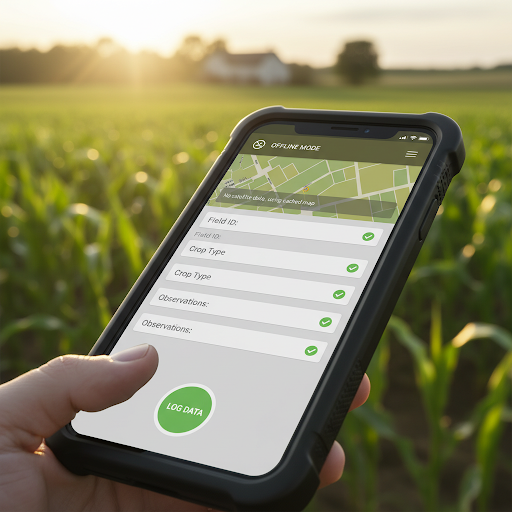
Offline data capture solves this problem by making farm operations independent of network availability. With mobile applications designed for offline use, data is captured at the field level in real time and synchronized automatically when connectivity is restored. FarmERP’s offline-first mobile capabilities ensure uninterrupted operations, accurate data recording, and consistent workflow execution—even in the most remote farming environments.
1. The Connectivity Challenge in Agriculture
Agricultural operations are often spread across rural and remote geographies where internet infrastructure is inconsistent. Field teams may face:
- Intermittent or no network coverage
- Delayed communication between sites
- Difficulty in accessing centralized systems in real time
This dependency on connectivity creates operational inefficiencies and disrupts data flow.
2. Why Online-Only Systems Fail in Rural Environments
Systems that rely entirely on internet connectivity break down in real-world farming scenarios:
- Data cannot be recorded during field activities
- Work gets paused until connectivity returns
- Teams revert to manual note-taking, introducing errors
- Data entry gets delayed and becomes inaccurate
This creates gaps in reporting, compliance, and decision-making.
3. What Offline Data Capture Really Means
Offline data capture allows users to record information directly into a mobile application without requiring an active internet connection.
Data is:
- Stored locally on the device
- Time-stamped at the moment of entry
- Synced automatically once connectivity is restored
This ensures continuity in operations without any interruptions.
4. How Offline Capabilities Ensure Reliable Farm Operations
A. Continuous Data Capture Without Network Dependency
Field teams can record activities anytime, anywhere; regardless of connectivity status.
This ensures that critical data such as input usage, labour activity, and crop conditions is always captured at the moment it occurs, preserving accuracy.
B. Elimination of Data Loss & Delayed Entries
Offline systems remove the need for temporary notes or memory-based recording.
This reduces the risk of missing, incorrect, or incomplete data, ensuring that all operational details are properly documented.
C. Seamless Sync When Connectivity Is Available
Once the device reconnects to the internet, all stored data is automatically synchronized with the central system.
This creates a smooth transition between offline and online modes without manual intervention.
D. Improved Coordination Across Distributed Teams
When data syncs back to the system, management and other teams gain visibility into field operations across locations.
This ensures better coordination between production, logistics, and management functions.
E. Operational Consistency Across Locations
Offline capability ensures that every farm, regardless of location, follows the same digital processes.
This standardization improves overall operational reliability and enables scalability across multiple geographies.
5. How FarmERP Enables Offline-First Farming
FarmERP is designed to function seamlessly in both connected and disconnected environments:
Fully Functional Offline Mobile App
Field teams can perform all essential operations without needing internet access.
Automatic Data Synchronization
Captured data syncs instantly once connectivity is restored, ensuring no manual uploads are required.
Geo-Tagged and Time-Stamped Data
Every activity is recorded with location and time metadata, ensuring data authenticity.
Integrated Workflow Execution
Offline operations remain linked with job cards, activities, and production workflows.
Centralized Visibility for Management
Managers receive complete data once synced, enabling informed decision-making.
6. Business Impact on Remote Farm Operations
Offline data capture delivers real operational advantages:
- Continuity of operations without dependency on network availability
- Higher accuracy in field-level data
- Reduced manual errors and rework
- Improved coordination across remote locations
- Better compliance and traceability readiness
It ensures that location is no longer a limitation for digital transformation.
7. Conclusion
Reliable farm operations require systems that work where the work happens; not just where the internet is available. Offline data capture empowers agribusinesses to operate efficiently even in remote environments, ensuring that data accuracy, workflow execution, and decision-making are never compromised.
With FarmERP, connectivity challenges no longer disrupt operations—farms remain digitally connected, even when offline.
Operating in remote areas and struggling with connectivity issues? Explore FarmERP’s offline-first mobile solutions at farmerp.com and ensure uninterrupted farm operations.