
How ERP Enables End-to-End Traceability in Agriculture
Summary
Global food supply chains are no longer linear; they are complex, interconnected ecosystems where a single product may pass through dozens of hands and multiple countries before reaching consumers. In this environment, traceability has become essential for ensuring transparency, food safety, and compliance with global standards.
Agriculture ERP platforms play a transformative role by connecting every stage of the supply chain; farm, packhouse, processing, logistics, export, and retail; into one unified digital system. Unlike traditional record-keeping or standalone farm apps, an ERP ensures that every action, inspection, and movement is recorded automatically and linked to the product’s identity.
This blog explores how ERP systems, especially FarmERP’s Agribusiness Cloud, enable reliable, real-time, end-to-end traceability for modern agribusinesses.
The Growing Demand for Traceability in Agriculture
Consumers, retailers, and global regulators increasingly want clear answers:
- Where did this food come from?
- Was it grown using safe and ethical practices?
- Can the supplier prove its quality and residue compliance?
Traceability has shifted from a compliance requirement to a market expectation, and agribusinesses that cannot prove product origin or quality risk losing access to high-value markets.
An ERP system provides the digital infrastructure needed to meet these expectations without burdening operations with manual paperwork.
What ERP-Driven Traceability Means
End-to-end traceability in ERP means:
- Every activity is automatically recorded
- Every batch/lot carries its digital identity
- Every process is connected—from sowing to shipping
- Every stakeholder has access to verified data
ERP ensures that no part of the supply chain is isolated, which is critical for achieving true, continuous traceability.
How ERP Creates Seamless Traceability Across the Value Chain
A. Capturing Source Data at the Farm Level
ERP connects with mobile apps and field teams to capture:
- Sowing and planting details
- Input usage
- Field inspections
- Pest/disease observations
- Harvest timelines
This is the foundation of authentic traceability.
B. Connecting Packhouse, Processing & Quality Workflows
In many businesses, most traceability gaps occur during post-harvest operations. An ERP prevents this by digitizing:
- Arrival logs
- Grading & sorting
- Packing and repacking
- Palletization
- Quality control stages (Field, Arrival, FG, Pre-dispatch)
- MRL testing records
Each product remains linked to its origin and quality status.
C. Managing Export Documentation & Compliance
ERP ensures export shipments are traceable and compliant by organizing:
- Lot-wise export mapping
- Containerization details
- Shipment documentation
- Route/mode specifications (sea, air, land)
This structure reduces errors and improves acceptance in global markets.
D. Linking Logistics With Product Identity
Logistics can break traceability when systems are disconnected. ERP prevents this through:
- Unified consignment tracking
- Transport partner logs
- Quantity reconciliation
- Delivery confirmations
This ensures that traceability continues beyond the farm and packhouse.
E. Real-Time Monitoring Through Dashboards
ERP dashboards provide management with a live view of:
- Lots in production
- Batches in processing
- Shipments in transit
- QC performance
- Compliance risks
Traceability becomes proactive, not reactive.
How FarmERP Strengthens Traceability
FarmERP enhances traceability through powerful features such as:
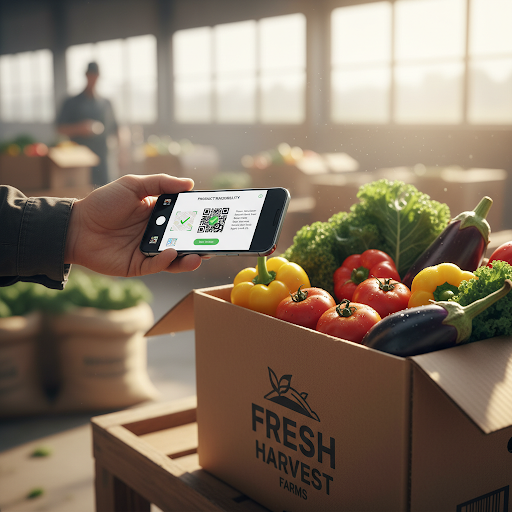
- F–QR Codes: Printed on boxes to reveal full product history
- Integrated QC: Every quality check tied to the batch
- MRL Compliance: Ensures residue limits meet global standards
- Packhouse-to-export linkage: No gaps between processing and shipment
- Digital evidence: Geotagged photos, videos, and inspection records
- Multi-location data sync: All sites connected in real time
This provides a complete, verifiable digital trail from farm to export.
Why ERP-Based Traceability Matters for Large Agribusinesses
ERP-enabled traceability helps organizations achieve:
- Increased buyer trust through transparent supply chains
- Higher export approval rates via compliance readiness
- Reduced rejection risk due to consistent QC
- Easier certification audits with structured digital records
- Better internal accountability across teams and operations
- Improved profitability through reduced waste and rework
In competitive markets, traceability becomes a strategic advantage.
Conclusion
End-to-end traceability is no longer complex or manual when powered by a modern ERP system. By integrating field operations, packhouse workflows, quality processes, logistics, and exports, an ERP like FarmERP turns fragmented data into a unified, trustworthy supply chain record.
With global buyers demanding transparency, ERP-driven traceability ensures that agribusinesses remain competitive, compliant, and future-ready.
Looking to build a transparent, audit-ready, and globally compliant agricultural supply chain? Visit farmerp.com to explore how FarmERP’s traceability capabilities can transform your operations.