
AI-Powered Crop Monitoring: How It Improves Yield & Sustainability
Summary
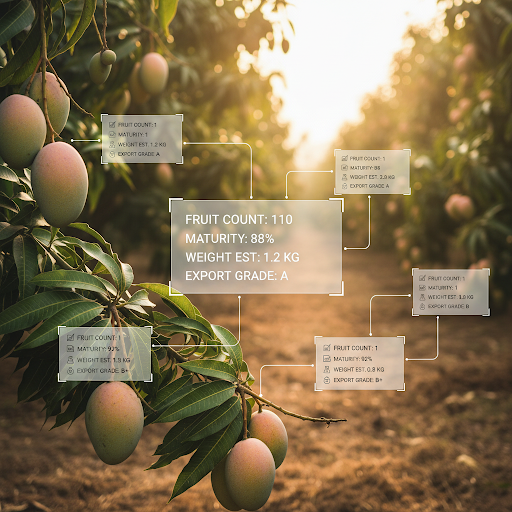
Agriculture in 2026 looks very different from the industry we knew a decade ago. What was once dependent on experience, estimations, and manual monitoring has now evolved into a data-driven, intelligence-powered ecosystem. Artificial Intelligence (AI) has become the backbone of modern agriculture by helping enterprises plan better, predict risks earlier, improve quality, reduce waste, and operate with unprecedented precision.
At FarmERP, AI isn’t just an add-on. It is woven into the daily workflows of farmers, packhouses, exporters, nurseries, greenhouse operators, and agribusiness leaders across the world. This blog expands on the top 10 AI technologies transforming agriculture in 2026, showcasing how these innovations solve real problems on the ground.
1. AI-Driven Labour Optimization
Labour management has traditionally been one of the most unpredictable cost components in farming. Workers perform multiple tasks across the day; sometimes in teams, sometimes individually and keeping track of activities manually leads to errors and inefficiencies.
In 2026, FarmERP’s AI-driven labour optimization transforms this process entirely. Using digital tools and behavioural patterns, AI helps:
- Identify worker efficiency trends
- Predict the ideal labour allocation for each field task
- Automate wage calculations for piecework, timework, and gang work
- Highlight activities that consume more labour hours than expected
The biggest benefit? Farmers get clarity. They know which tasks take time, which workers excel where, and how labour spending influences productivity.
2. AI-Powered Quality Assessment & Compliance
Quality failures often come as a shock; especially for exporters. A shipment may look perfect at dispatch but might not meet standards during arrival. AI reduces this gap by embedding objectivity into quality assessment.
FarmERP’s AI-powered QC tools:
- Scan produce for size, shape, colour, and uniformity
- Flag anomalies that human eyes might miss
- Assist with MRL compliance through automated checks
- Provide consistent QC scoring across stages: field, arrival, FG, and pre-dispatch
This ensures consistent, compliant, and export-ready produce without the guesswork.
3. Predictive Yield & Harvest Forecasting
Predicting crop yield has always been part science, part intuition. But as climate variability increases, historical patterns no longer guarantee accurate results.
FarmERP uses AI to create highly actionable forecasting models by combining:
- Real-time field data
- Growth stage analysis
- Weather models
- Historical performance insights
These predictions are not merely reports, they become decision-making tools. They help plan logistics, align labour availability, estimate revenue, and reduce harvest-time chaos.
4. AI-Enabled Traceability & QR Intelligence
Consumers are more curious than ever about the origin of their food. Retailers demand transparency. Exporters need stringent documentation.
With AI-driven traceability, FarmERP enables:
- Automated lot creation and linking
- QR codes with complete product journeys
- Real-time traceability across production, processing, and shipping
- Recall readiness with minimal disruption
The impact is huge: trust increases, compliance becomes easier, and brands build stronger market presence.
5. AI for Nursery & Cost Accounting Precision
Nursery operations involve thousands of plants, each with different growth cycles, input needs, and survival rates. Traditional costing methods often fail to provide plant-wise accuracy.
FarmERP’s AI models simplify nursery accounting by:
- Allocating cost per plant batch
- Predicting WIP value at each growth stage
- Recommending resource adjustments to prevent losses
This gives nursery managers unprecedented visibility into which plants are profitable and which require intervention.
6. AI-Assisted Banana Harvest Prediction
Banana farming is deeply dependent on precise timing. Harvesting too early reduces quality; harvesting too late affects shelf life.
FarmERP’s AI-powered banana module analyzes:
- Ribbon tagging data
- Crop growth stages
- Environmental factors
- Historical yield patterns
It then predicts harvest timelines week-by-week, making planning smoother and reducing market wastage.
7. AI-Based Pest & Disease Identification
Farmers often struggle to detect early symptoms of infestation. By the time damage becomes visible, it’s often too late.
FarmERP’s FarmGyan AI module solves this with:
- Mobile-based image scanning
- Instant pest/disease recognition
- Suggested corrective actions
- Trend analysis to prevent recurring outbreaks
This empowers even remote field teams to act quickly and accurately.
8. Predictive Sales, Inventory & Expense Forecasting
Agribusinesses face constant uncertainty in market behaviour. AI-based forecasting answers crucial questions:
- How much inventory will we need?
- What will demand look like next month?
- Which expenses will spike in the upcoming season?
FarmERP’s forecasting engine helps businesses stay ahead by reducing stockouts, preventing overproduction, and guiding smarter budgeting.
9. Plot-Level Intelligence with AgIntel10X
Every farm plot behaves differently. Soil, microclimate, water retention, and pest susceptibility vary dramatically even within a single farm.
AgIntel10X brings this variability under control by offering:
- Crop health scores
- Pest/disease probability alerts
- Water requirement predictions
- Weather-linked risk models
- Growth stage recognition
These insights help farmers optimize resources and improve consistency across plots.
10. AI-Powered Conversational Assistants for Farm Data
The complexity of ERP systems can overwhelm new users. With AI chatbots like Balee, FarmERP makes data accessible through simple conversations.
Users can ask:
- “Show me today’s harvest summary.”
- “How much did we spend on labour this week?”
- “What is the predicted yield for plot 12?”
The chatbot fetches answers instantly, making AI interaction natural and intuitive.
Conclusion
Artificial Intelligence has become the silent partner behind some of the world’s most efficient agricultural enterprises. From improving labour efficiency to predicting demand, from assessing quality to powering traceability; AI is making agriculture more resilient, profitable, and future-ready.
FarmERP continues to lead this transformation by building AI tools deeply connected to real-world agricultural challenges. With each innovation, we move one step closer to a smarter, more sustainable global food system.
Ready to embrace the future of agriculture? Visit farmerp.com and explore how AI can transform your farm or agribusiness operations today.